1. What is QRadar SIEM?
Security Information and Event Management (SIEM) platforms help security teams collect security-relevant telemetry, investigate activity across multiple systems, and identify patterns that may indicate an attack or policy violation. IBM QRadar SIEM is one platform in this category.
QRadar collects and processes event data from log sources and can also analyze network flow data. It normalizes supported data into fields that analysts can search and correlate, then applies rules and other configured analytics to help surface activity that deserves investigation.
Rather than investigating a firewall, endpoint, identity provider, and server independently, analysts can use a SIEM to bring relevant signals together, build a timeline, and assess whether separate events may be related.
2. How QRadar works
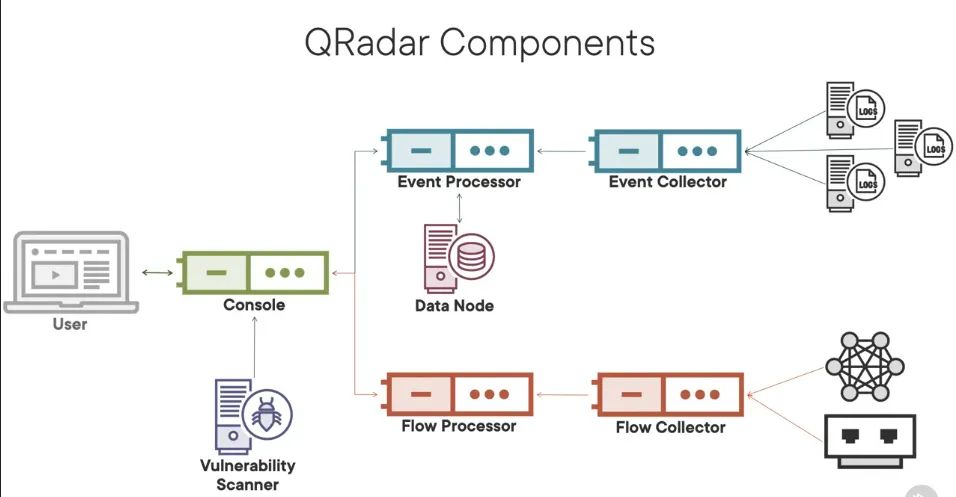
At a high level, QRadar's workflow can be understood as a pipeline:
| Stage | What happens |
|---|---|
| Collect | Receive security events from sources such as firewalls, servers, identity systems, endpoint products, and other supported devices. Depending on the deployment, QRadar can also collect or receive network flow data. |
| Parse and normalize | Interpret supported event formats and map useful values—such as event name, username, source IP, and destination IP—to fields analysts can search and rules can use. |
| Correlate | Evaluate events and flows against configured rules, building blocks, and other supported detection logic. |
| Generate offenses | When configured rule criteria match, QRadar can create or update an offense to group related activity and provide a starting point for investigation. |
| Investigate and respond | Analysts review related events, source and destination details, timelines, and other context, then follow incident procedures or configured response actions. |
Events and flows provide different perspectives. An event typically records an action at a point in time—for example, a successful login. A flow describes communication between hosts over a network session. Used together, they can help an analyst connect an account activity event with relevant network behavior.
Offenses are generated from configured correlation logic. Analysts still need to validate the underlying events, check context, and determine whether the activity is malicious, authorized, or a false positive.
3. Core capabilities
Security event collection and log management
QRadar accepts data from supported log sources and uses device support modules (DSMs) and parsing/normalization to make records more useful for investigation. Coverage depends on correct source configuration, supported formats, parsing quality, and whether the data being collected includes the fields required by your use cases.
Rule-based detection and correlation
QRadar's Custom Rules Engine (CRE) evaluates event and flow data against configured rules. Rules may test one event, a sequence or combination of conditions, flow activity, or offense-related characteristics. Responses can include notifications or offense generation, depending on the rule configuration.
Investigation and search
Analysts can search event and flow records, inspect raw and normalized data, review offenses, and use query and reporting features to support investigations. The quality of the investigation depends on telemetry coverage, retention, field normalization, time synchronization, and the analyst's interpretation of the evidence.
Analytics beyond basic correlation
QRadar capabilities vary with the product version, deployment model, licensed components, and installed applications. Some environments may add specialized analytics or user-behavior capabilities, but it is not accurate to assume every QRadar deployment automatically includes every machine-learning feature. Confirm the capability and prerequisite licensing in the documentation for the system in use.
4. Benefits for security operations
- Faster triage: a central place to review related events can reduce the time spent switching between individual consoles, provided the necessary data is onboarded and normalized.
- Broader visibility: combining logs and network flow context can help analysts understand activity across hosts and security controls.
- Repeatable detection: tuned rules and reusable building blocks help teams apply detection logic consistently.
- Investigation context: offenses can group correlated activity and give analysts a starting point for determining what happened, when, and which systems or accounts were involved.
- Operational reporting: saved searches, dashboards, and reports can help teams track security activity and communicate findings.
These benefits are not automatic. They depend on the quality of integrations, rule logic, system sizing, data retention, and the SOC's investigation and response processes.
5. Compliance considerations
A SIEM can support compliance work by centralizing relevant audit records, improving monitoring, and helping teams produce evidence for selected control activities. QRadar may be one part of a broader control environment for frameworks or regulations such as PCI DSS, HIPAA, or GDPR, depending on the organization's scope and requirements.
Compliance depends on the full set of required technical, administrative, and organizational controls. Retention settings, access controls, monitoring coverage, reporting, and evidence-handling procedures must be mapped to the applicable obligations and validated independently.
6. Important considerations
Before relying on QRadar for a use case, confirm that the relevant systems send the necessary telemetry, that the log sources parse as expected, and that rules are tested against both positive and negative examples. Monitor ingestion health, event rates, storage and retention, and whether offenses contain enough context to be useful.
Also distinguish detection from response. QRadar can generate offenses and configured responses, but effective incident handling still requires an agreed triage process, escalation criteria, evidence preservation, and a method to document outcomes.
7. Official references
- IBM QRadar: Events and flows
- IBM QRadar: Rules and offenses
- IBM QRadar: Getting started for security analysts
Feature availability, supported log sources, licensing, and UI details vary by QRadar edition and release. Use IBM documentation for the version deployed in your environment.
For QRadar detection tuning or SIEM coverage assessments, contact me with the use case, log-source coverage, and current detection gaps.